
Tuff Shed Site Prep & Utilities: The Glendale Owner’s Guide
Tuff Shed site prep and utility connections in Glendale typically run $4,800-$12,500 for a standard studio or office shed, depending on whether you’re bringing in electrical, water, or sewer. We stock Tuff Shed-compatible foundation hardware, conduit, and connection kits, and most Glendale installs are completed in one to two working days once permits clear. Most owners discover their site prep is inadequate when the shed arrives on a truck and the pad isn’t level, the electrical stub-up is in the wrong location, or the city stops the project because the setback doesn’t match what was drawn.
Which Tuff Shed Models This Applies To
Tuff Shed’s product lines fall into three categories that affect site prep and utility routing: the Premier PRO Series with its 50-year rated siding, the Premier Ranch with its 7/12 roof pitch, and the standard TR-700 and TR-800 economy lines. The PRO and Ranch series require a 4-inch minimum concrete slab with footings to match the engineered snow load stamped on the drawings; the TR series can sometimes sit on a gravel pad with perimeter blocking, though Glendale’s clay-heavy soil in the Verdugo Woodlands area usually pushes us toward a full slab anyway.
Identifying your model matters for utility placement. Tuff Shed stamps a metal ID tag inside the door frame on the hinge side; the first four digits indicate the series, the next two the nominal width. A “PROR-10” tag means Premier PRO Ranch, 10-foot width. The electrical stub location shifts 18 inches between Ranch and PRO gable orientations, and getting this wrong means cutting into finished siding or running exposed conduit. We carry both the OEM Tuff Shed foundation anchor kit (the red-bagged hardware set shipped with most units) and a heavier-duty Simpson Strong-Tie equivalent rated for Glendale’s seismic zone D. The Simpson set costs roughly 15% more but includes longer wedge anchors for the deeper footings the city often requires on hillside lots north of Mountain Street.
Signs Your Tuff Shed Site Prep & Utilities Is Failing
- Doors swing open or stick seasonally. This usually means the slab or gravel pad wasn’t compacted to 95% relative density before the shed went down. Glendale’s wet winters and dry summers cause expansive clay soil to shift; a 4-inch slab without proper base rock will torque the frame enough to throw door alignment off by a quarter inch or more.
- GFCI trips repeatedly inside the shed. The underground feeder conduit wasn’t bedded in sand or got nicked during backfill. Moisture wicks in where the conduit enters the slab, especially on north-facing yards in the Chevy Chase Canyon area where the ground stays damp longer. The fix isn’t the outlet; it’s re-running the conduit with proper slope to a junction box.
- Water stains on the interior floor after rain. The slab was poured flat instead of with a 2% slope away from the door, or the Tuff Shed’s pressure-treated sill plate was set directly on concrete without a foam gasket. In Glendale’s older neighborhoods like Rossmoyne, we’ve seen this where homeowners poured their own “quick pad” over a weekend.
- City red-tags the electrical or plumbing rough. The utility trench depth is wrong (24 inches minimum for electrical in California, 12 inches for conduit with GFCI protection) or the setback from the property line doesn’t match the approved site plan. Glendale’s Planning Division measures from the face of the eave, not the wall, on sheds over 120 square feet.
- Shed sits visibly lower on one corner after two years. The footing wasn’t dug below the organic topsoil layer, or no rebar was used in a slab that should have had #4 bars at 18 inches on center. We’ve replaced three Tuff Shed pads in the Glenoaks Canyon area where the original installer skipped the rebar to save $400 in material.
Replacement Cost & What’s Included
In Glendale, full site prep and utility hookup for a Tuff Shed runs $4,800-$12,500 installed, with the spread driven by three factors: whether we’re replacing an existing failed pad or starting from bare soil, how many utilities are involved (electrical alone vs. electrical plus water/sewer), and whether the lot requires a retaining wall or stepped footings for slope.
A typical mid-range project, electrical-only on a level lot: $6,200-$7,800. That includes permit-ready drawings, the 4-inch slab with #4 rebar, the 3/4-inch EMT conduit run from your main panel with a dedicated 20A breaker, and the Tuff Shed anchor kit installed to manufacturer spec. Water and sewer add $2,800-$4,200 depending on distance to existing mains. Every project is quoted with a written price before work starts, per Haven Standard Clause 1. The number on the page is the number we work from. Our 365-Day Done Right Promise covers the slab, the utility connections, and the permit sign-off; if the city comes back with a correction notice tied to our work, we handle it.
DIY or Call Us?
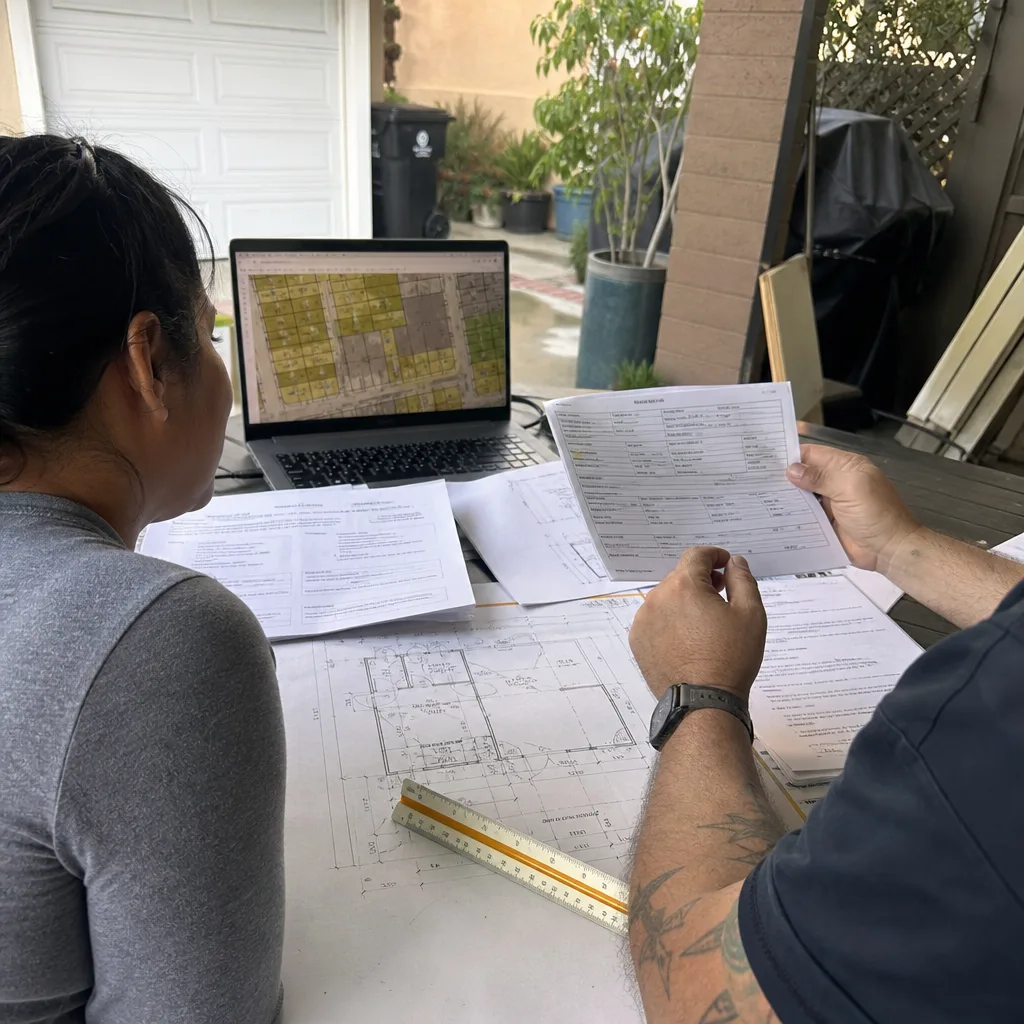
There’s a clear line between what an owner can verify and what requires a licensed contractor in Glendale. You can check your Tuff Shed’s model tag, measure the existing slab for level with a 4-foot straightedge, and confirm whether your electrical panel has breaker space. What you shouldn’t attempt: pouring a structural slab without a city permit (Glendale requires engineered drawings for any detached structure over 120 square feet), trenching for electrical without calling DigAlert (811), or installing your own subpanel inside the shed. California requires a licensed electrician for any new circuit extension; homeowner permits for electrical work are not issued in Glendale.
The most expensive mistake we see is the owner who pours a pad, installs the shed, then calls us to “just add the electrical.” We have to cut into finished siding, sometimes remove the shed entirely to trench properly, and the permit path gets harder because the structure already exists. If you’re pricing a Tuff Shed and haven’t broken ground yet, call us first. We’ll look at your site plan and your Tuff Shed order sheet, then tell you exactly what the prep and utilities should cost before you commit. Free estimates: (424) 325-4322.
FAQs
A properly installed slab and electrical connection should last 30-50 years, which is the useful life of the Tuff Shed itself. The failure points we see are almost always installation errors, not material wear. Call (424) 325-4322 for an exact quote on your site - estimates are free.
Sometimes. A slab with minor settling can be mud-jacked if the rebar is intact; electrical conduit with a single break can be spliced at a junction box if the run is accessible. If the slab has cracked through or the conduit is collapsed underground, replacement is the only code-compliant fix. We document what we find with photos and give you both options where they exist.
Concrete cure time controls the schedule: five days minimum before we can set anchors, seven days before full load. The actual forming, pour, and utility rough-in takes two working days on a standard lot. Permits in Glendale currently run three to four weeks for a simple electrical addition, longer if the project triggers a full site plan review. We handle the submittal and track the plan check comments.
Yes. We keep the OEM anchor kits, Simpson seismic hardware, 3/4-inch EMT conduit, and direct-burial cable in stock for Glendale-area Tuff Shed projects. If your model uses the older 5/8-inch wedge anchor pattern (pre-2019 TR series), we carry those too - most suppliers have shifted to the 3/4-inch spec and the smaller hardware is getting harder to source.
Written by Nadia Ellery, Owner & Principal Designer, Ellery ADU Studio Glendale at Ellery ADU Studio Glendale, serving Glendale and nearby areas.